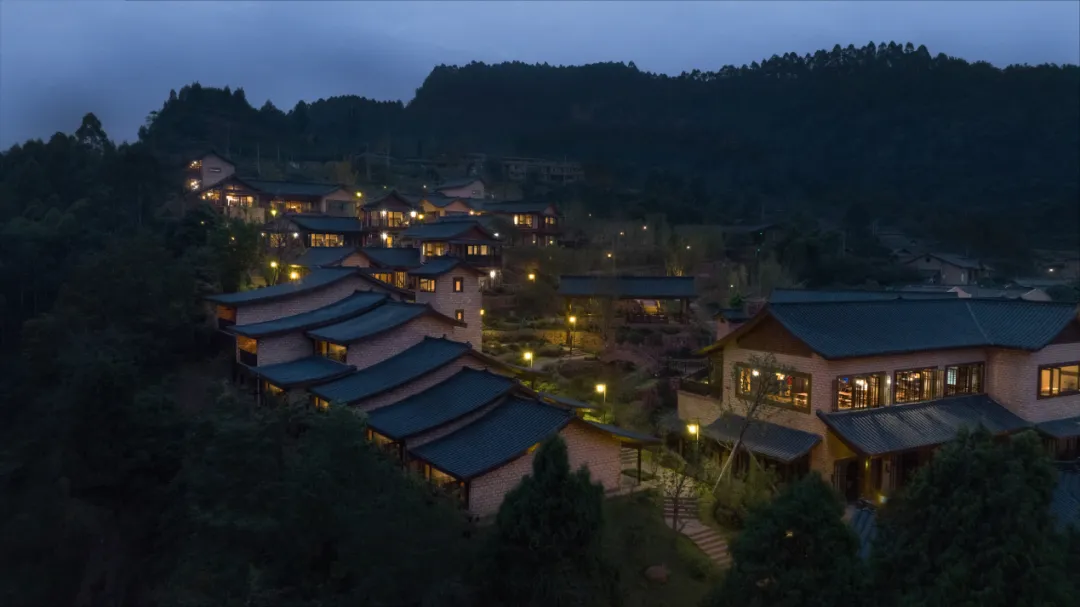
▲ A night view of Xinfu Ridge, looking back from a high point on the Ancient Tea-Horse Road. © Existence Photography
Continuity and Symbiosis of Ancient Villages along the Ancient Tea-Horse Road: Xinfu Ridge
Xinfu Ridge evolved organically from a dialogue with the historic mountain villages nestled along the Tea-Horse Road. Guided by a deep reverence for the past and the surrounding environment, we meticulously sought a delicate equilibrium. The scale of the architecture inherits the "scattered, small, and refined" character of the old village, preserving its touching, primal rural essence of being "ancient, serene, and artlessly simple."
2022 United Nations Asia-Pacific Urban Landscape Award
"This is a pioneering and singular project, masterfully crafted to form a sanctuary for the heart."
"The case of Meishan, China, charts a future for ancient villages hidden deep in the mountains, creating a simple and captivating spiritual homeland. I am thrilled to have discovered such a remarkable work! This underscores the very importance of ATA."
— Yū Satō, Chair of the Asia-Pacific Urban Landscape Award Jury
19th Elite Habitat Award, Ministry of Science and Technology of the People's Republic of China
The design of "Xinfu Ridge" is people-centered, integrating green, healthy, cultural, and sustainable development concepts into a residential community. Its eco-habitat philosophy, which blends heritage with innovation, garnered high acclaim from the jury, distinguishing it among a multitude of entries.
"Long ago, my esteemed father / Practiced benevolence and filial piety at home. / Our home held five acres of garden / Where young phoenixes gathered among the Paulownia blossoms."
— Su Shi, "The Rare Magpie"
Abundant flora, where flowers and birds coexist—this beautiful imagery is Su Shi's cherished memory of a blissful childhood in Meishan. This project is situated in Danling County, Meishan City, Sichuan Province—the very place where Su Shi began his scholarly journey. Shunlong Township's Xinfu Ancient Village lies 13 kilometers from Danling's county seat and 130 kilometers from Chengdu. Su Dongpo (Su Shi) received his early enlightenment here; the Ancient Tea-Horse Road traverses the area; and it was examined as a Chinese exemplar during UNESCO's "Culture 2030 | Urban-Rural Development: The Future of Historic Villages and Towns" international conference.
Yet, this time-honored and profound "simple original homeland," facing a steady influx of tourists, lacked adequate service facilities to fulfill the visitor experience of a mountain life "resting against a gentle breeze while gazing upon the ancient road." The "Xinfu Ridge" project, through a more innovative and sustainable form of a clustered homestay settlement, revitalizes the ancient village's historical and traditional resources. It has brought tangible benefits to the local inhabitants while navigating the challenge of respecting historical heritage alongside rural tourism development.
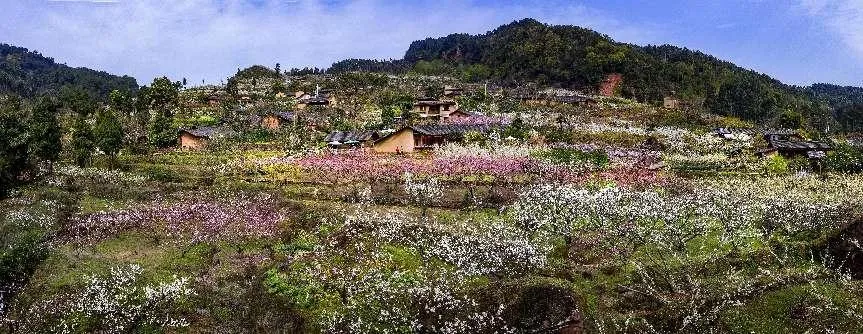
▲ Xinfu Ancient Village nestled upon Shunlong Mountain in Danling. © Danling Culture and Tourism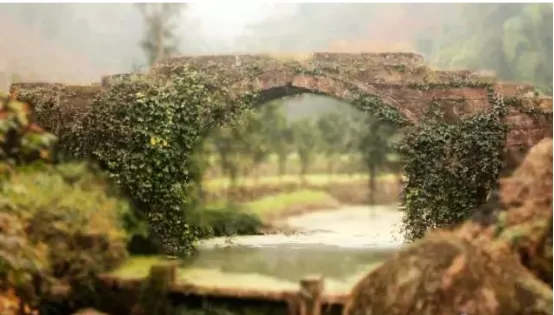
▲ A Qing Dynasty stone bridge within Xinfu Ancient Village. © Danling Culture and Tourism
Presently, amidst commercial stimuli and urban renewal, we find ourselves in a state of drifting uncertainty, caught between past and future. Confronting the future within a modernizing context, nostalgia perhaps offers a form of certainty, and culture becomes the pivotal point for reclaiming the value of regional architecture. "Xinfu Ridge" manifests a concern for the natural environment and ecological balance, coupled with a humanistic appeal, responding to our inner yearning for an ideal environment.
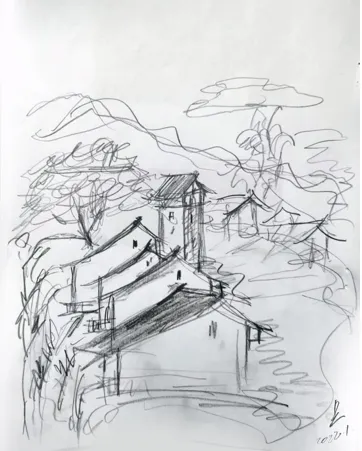
▲ Conceptual sketch for Xinfu Ridge. © Liu Weibing
Before commencing the design of "Xinfu Ridge," we too undertook this four-step process of "learning from nature externally, gaining inspiration from the heart internally":
1、Fully listening to the opinions and suggestions of local residents to understand the village's traditions, customs, climate, and geography.
2、Consulting Danling County's local records from the Qing Dynasty and the Republican era to comprehend the regional cultural history, landscapes, and features.
3、Studying local traditional architectural construction techniques, familiarizing ourselves with indigenous structural methods and the properties of local building materials.
4、Contemplating cultural expressions that innovate within tradition, conceptualizing how to extend the ancient village's charm using contemporary vocabulary.
Ultimately, "Xinfu Ridge" neither replicates Xinfu Ancient Village nor deliberately seeks novelty for its own sake. Adhering to the principle of not "disturbing" the tranquil ancient village and the naturally beautiful mountain forest, it draws upon local traditional "geomancy" wisdom. Employing an optimal "scattered-point" layout, it creates an ecological homestay settlement well-adapted to the local geography and climate.
By combining traditional ecological building materials with modern architectural language, it creatively shapes inventive spaces that align with the mountain's natural grain. As Master Huang Binhong stated: "Mountains have veins, waters have sources, roads enable passage; clouds and mist emerge and vanish, trees and plants flourish—method is complete, spirit arrives. Seeming discontinuous yet connected, winding and circling, manifesting the distinct qualities of level-distance, high-distance, and deep-distance—all appearing entirely natural, without a trace of artificial contrivance. This is the highest achievement."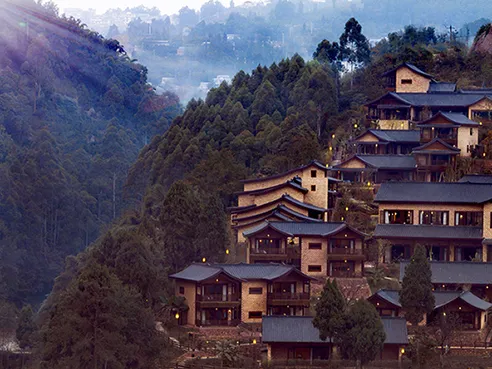
▲ Viewing Xinfu Ridge in the dawn light from Happiness Ancient Village. © Existence Photography


抖音二维码


微信公众号

QQ群:

小红书二维码
(028)65292560
Floor 6, Building 3, ShuDu Center, No. 138, Tianfu 2nd Street, High-tech Zone, Chengdu City, Sichuan Province
Links